
If you're managing changes across multiple client environments, you've probably lived this sequence already. A normal change gets approved in a hurry, implementation starts, something breaks, and the next hour disappears into Teams threads, email forwards, and ticket comments trying to answer one basic question: who owned the decision?
That's the moment when a RACI matrix template stops being admin overhead and starts looking like operational hygiene. But most templates online are built for one company with one hierarchy. MSPs don't work that way. One client wants their IT director as approver. Another wants finance involved for anything touching a licensed system. A third delegates routine approvals to a site manager but escalates network changes to corporate leadership.
A useful RACI matrix template for an MSP has to do more than label roles. It has to survive multi-tenant reality, shifting approval chains, audit scrutiny, and change types that don't behave the same way. Static spreadsheets rarely hold up. A tenant-aware structure does.
Why Your Change Process Needs More Than Just a Template
The biggest mistake MSPs make with a RACI matrix template is treating it like a document problem. It's a governance problem.
A generic template can look clean on day one and still fail on the first meaningful client change. The reason is simple. Most downloadable RACI files assume one org chart, one approval chain, and one set of stakeholders. MSPs operate across many client entities, each with different decision rights, risk tolerances, and escalation paths.
That gap matters because change ambiguity is expensive. According to the 2023 ITSM Industry Report on RACI adoption in MSPs, 74% of MSPs and IT operations teams use RACI matrix templates, and teams that implement them effectively correlate with a 35% decrease in failed technology changes and a 42% drop in emergency incidents. Those results don't come from downloading a spreadsheet. They come from making ownership explicit and repeatable.
Multi-tenant MSP work breaks generic templates
In a single-company environment, you can often get away with a static chart. In an MSP, that approach collapses fast.
One client might define the service desk manager as accountable for user-impacting changes. Another might require the client-side operations lead. A third may insist on a Virtual CAB for anything with infrastructure risk. If your RACI matrix template hard-codes one accountable role across all clients, it's wrong before the change window even opens.
Practical rule: If your template assumes the same approver for every client, you don't have a RACI model. You have a placeholder.
Confusion isn't the main risk
Many teams believe unclear roles create delays. They do, but that's the easy part. The harder issue is traceability.
When ownership is vague, three things usually happen:
- Approvals blur: Teams confuse “copied on the email” with “approved the change.”
- Implementation drifts: Engineers make reasonable decisions in the moment, but nobody can prove who had authority.
- Audits get ugly: Evidence lives across inboxes, chat threads, and tickets instead of a single governed workflow.
A solid RACI matrix template fixes those issues only when it reflects how your MSP operates across clients. That means role mapping by tenant, not by assumption. It also means treating the template as the front end of a system, not the whole solution.
Decoding the RACI Roles Responsible Accountable Consulted Informed
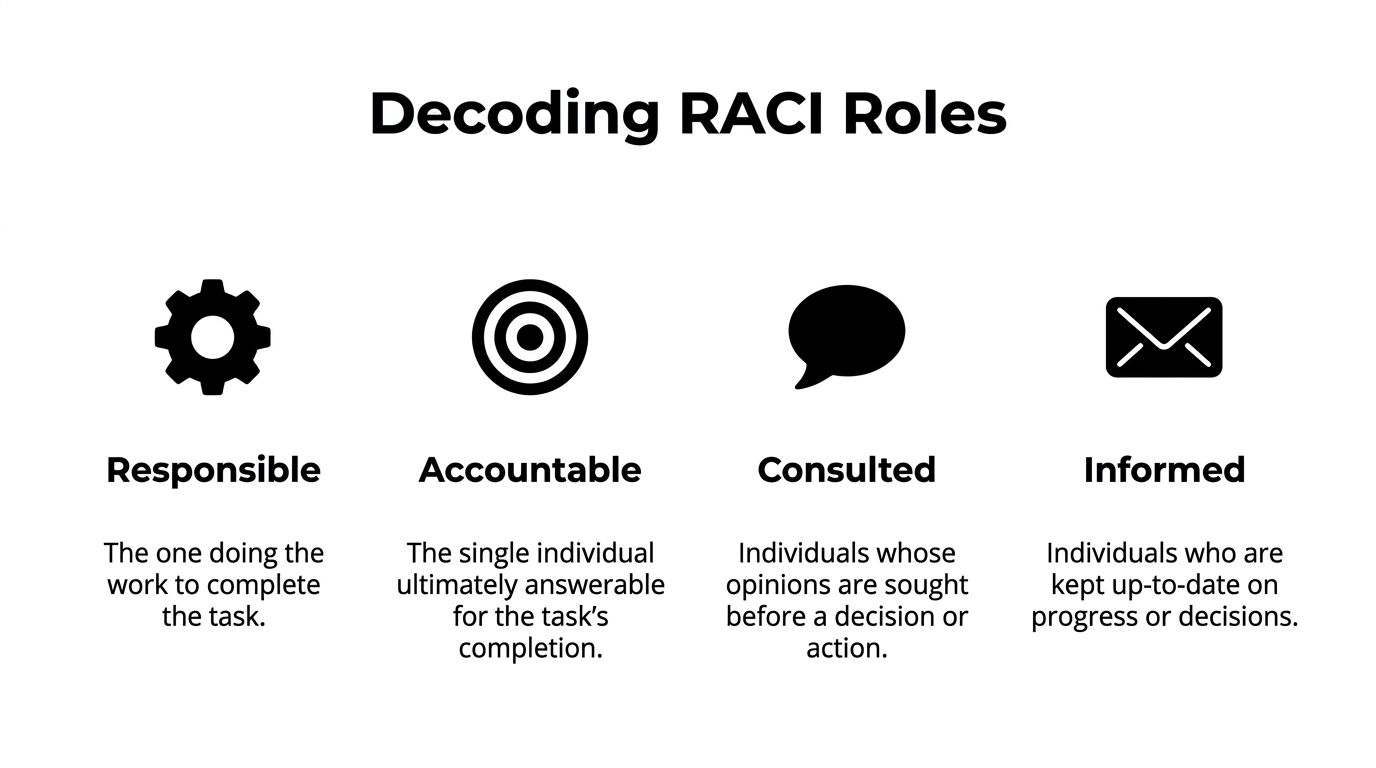
RACI only works when everyone uses the terms the same way. That sounds obvious, but in practice most friction comes from teams using familiar words loosely. “Responsible” gets mistaken for “owns it.” “Accountable” gets spread across managers to avoid conflict. “Consulted” becomes a parking lot for anyone with an opinion.
The model has been around for a long time for a reason. The RACI matrix was formally integrated into PMI's PMBOK Guide in 1996, which codified it as a global standard. By 2010, it was a mandatory competency for over 800,000 certified project managers, as noted in PMI history of RACI in PMBOK.
What each role actually means in practice
In MSP change control, the cleanest interpretation is the one that survives stress.
Responsible is the person doing the work. That's the engineer implementing a firewall rule, the technician creating the account, or the service desk analyst preparing the rollback notes. If nobody is clearly responsible, work stalls because everyone assumes someone else has it.
Accountable is the single owner of the outcome. This person answers for whether the task is completed correctly and whether the decision was appropriate. They may not touch the keyboard. They still own the result.
Consulted is a two-way role. These are the people whose input materially affects the task before it's done. Not everyone with context belongs here.
Informed is one-way communication. They need visibility, not decision rights.
The fastest way to break RACI is to confuse visibility with authority.
RACI role definitions
| Role | Meaning | Key Responsibility |
|---|---|---|
| Responsible | Performs the work | Executes the task or deliverable |
| Accountable | Ultimately answerable | Owns the outcome and final decision |
| Consulted | Provides input before action | Advises based on expertise |
| Informed | Kept updated | Receives status or decision notifications |
A practical MSP example helps:
- Responsible: Network engineer applies the switch configuration.
- Accountable: Change owner or designated approver accepts the risk and owns the result.
- Consulted: Security lead reviews exposure before implementation.
- Informed: Client point of contact receives the approved schedule and outcome.
The role pair that causes most trouble
Teams usually struggle with Responsible versus Accountable. The distinction is easier if you tie it to execution versus ownership.
- Responsible answers: Who is doing the task?
- Accountable answers: Who is on the hook if the task is late, wrong, or poorly approved?
In smaller environments, one person can hold both roles for a task. In MSP operations, that's common for low-risk work. What doesn't work is splitting accountability between multiple people because nobody wants the political tension of assigning one owner.
If you're documenting these distinctions inside platform permissions, mapping them to formal access roles helps prevent drift. A useful reference is ChangeBreeze account permissions and the six ITIL-based roles, which shows how governance language can translate into operational access control.
How to Build and Populate Your RACI Matrix
A workable RACI matrix template starts with structure, not software. Teams often open Excel first and start filling cells before they've defined the work or the roles. That creates a chart that looks complete but solves nothing.
The build process is straightforward when you keep it disciplined. According to ITSM benchmarks for creating a RACI matrix template, a rigorous approach begins by decomposing the work into 15–25 discrete deliverables per phase, followed by a stakeholder workshop that often reveals 300–500% more roles than initial assumptions. That last point matches what happens in real MSP environments. The first draft is almost always too shallow.
Start with deliverables not vague activities
Rows should represent concrete deliverables or decisions, not fuzzy activity labels.
Good rows look like this:
- Change logged and categorized
- Risk assessment completed
- Implementation plan approved
- Rollback plan reviewed
- Client approval recorded
- Post implementation review completed
Weak rows create arguments because nobody knows when they're finished. “Prepare change” is vague. “Implementation plan completed” is auditable.
For a normal change, I usually map the lifecycle from intake through PIR. For a standard change template, I map only the repeatable control points. For emergency changes, I keep the list tight enough to support speed but detailed enough to preserve traceability afterward.
Map roles before you map names
Use functional roles in the columns first. Don't start with people.
A multi-tenant MSP matrix often includes roles like:
- MSP change manager
- Service desk lead
- Senior engineer
- Client technical approver
- Client business approver
- Account manager
- Security reviewer
- Operations manager
People leave, rotate, cover vacations, or wear multiple hats. Roles stay stable longer than names do. When you build around roles, you can reuse the same RACI matrix template across clients without rewriting the logic each time.
Field note: If a matrix has personal names baked into the structure, it usually expires the first time someone changes jobs.
The workshop step is where hidden dependencies show up. Licensing owners, business app managers, compliance contacts, and regional approvers often appear late if you rely on assumptions. Pull them in early and you avoid “surprise stakeholders” two hours before the change window.
Assign letters with hard rules
Once rows and columns are defined, fill the matrix with discipline.
Start with Accountable first. Every row needs one clear owner. Then assign Responsible. Add Consulted only where input changes the result. Add Informed for the people who need visibility but not influence.
A practical review pass should check for these conditions:
- One accountable owner per row: More than one creates tie votes and slow approvals.
- At least one responsible role: If nobody executes, the row is ceremonial.
- Limited consulted roles: Overuse creates meetings, not decisions.
- Blank cells are fine: Not everyone belongs on every task.
A spreadsheet can still be useful at this stage if you build guardrails into it.
- Use dropdown validation: Restrict entries to R, A, C, and I so typos don't create fake role values.
- Highlight missing A assignments: Conditional formatting should flag any row without accountability.
- Separate tenant mappings: Keep a base process matrix and a per-client role overlay instead of cloning entire files endlessly.
Build a base matrix and a tenant overlay
This is the structural fix most MSPs need.
Your base matrix defines the workflow tasks common across clients. Your tenant overlay defines which client-side and MSP-side roles fill those slots for each customer. That lets you keep one service model while changing the accountable path by tenant.
A simple pattern looks like this:
| Base Task | MSP Role | Tenant-specific role |
|---|---|---|
| Approve implementation window | Change manager | Client operations approver |
| Approve business risk | Account manager | Client business owner |
| Validate technical readiness | Senior engineer | Client IT lead |
| Receive change outcome | Service desk lead | Client point of contact |
That approach beats duplicating a separate spreadsheet per client. Duplication creates drift. A shared base model with tenant-specific role mapping preserves consistency while respecting client governance.
Adapting RACI for Different MSP Change Types
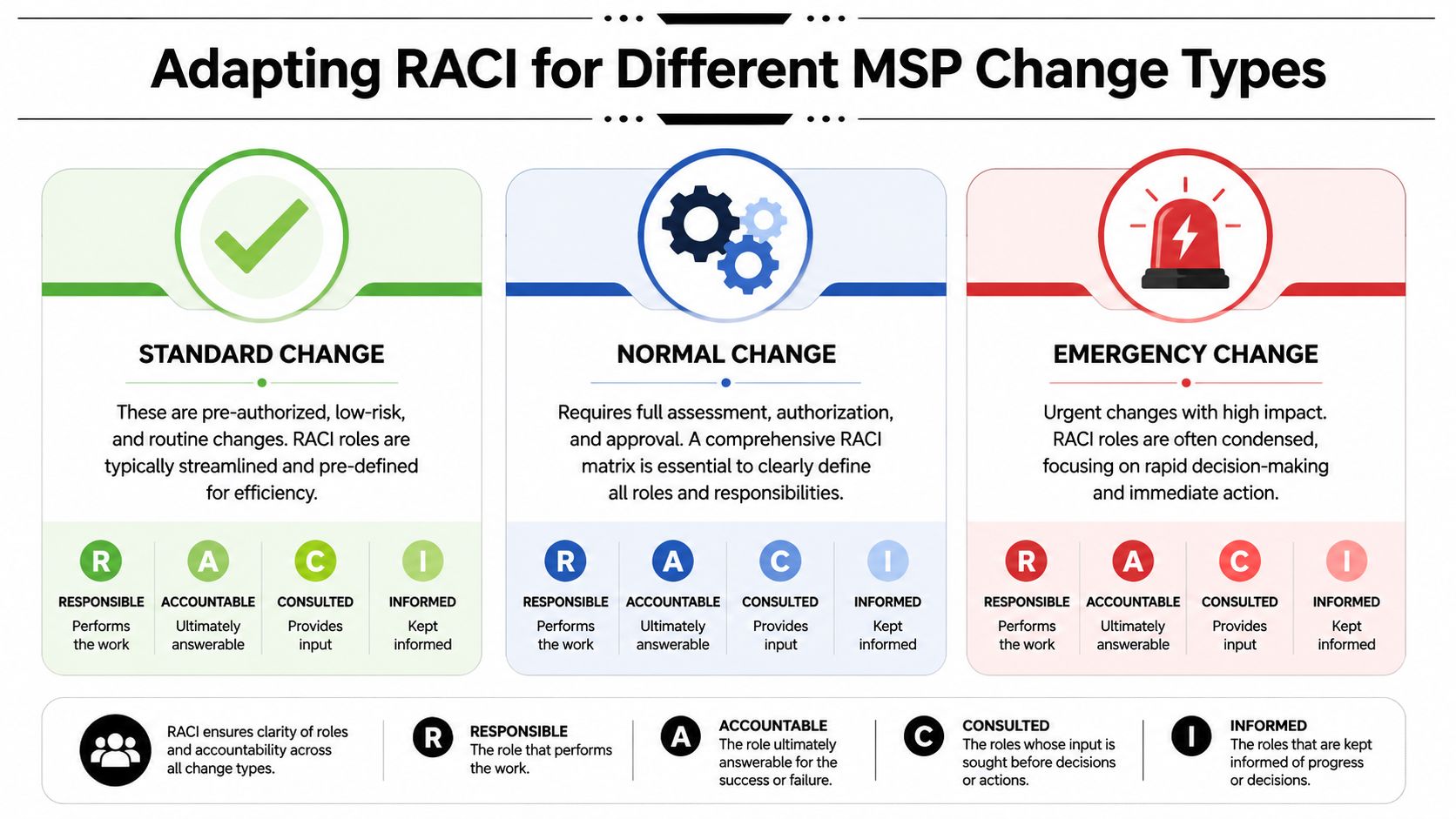
One reason many RACI matrix templates fail is that they treat every change the same. Standard, normal, and emergency changes don't need the same level of role design. If you force one model onto all three, you either slow down routine work or under-document risky work.
Standard changes work best with fixed mappings
Standard changes are where pre-defined RACI delivers the most value. These are repeatable, low-risk changes with a known method, known rollback, and an accepted approval path.
For these, keep the matrix lean. You don't need to rediscover ownership every time someone creates a mailbox, deploys an approved software package, or runs a routine maintenance task. The roles should already be established and linked to the standard change record.
What works:
- Pre-approved ownership
- Consistent responsible roles
- Minimal consulted involvement
- Clear informed notifications
What doesn't work is adding ad hoc approvers to routine work because one client manager wants more visibility. That turns a standard change into a normal one operationally, even if the label never changes.
Normal changes need tenant-aware accountability
Here, the MSP problem becomes real.
Normal changes require assessment, scheduling, technical review, approval, and communication. The task sequence may be similar across clients, but the Accountable role often changes per tenant. One client may require their internal IT director for production-impacting work. Another may accept the MSP account manager for low-to-moderate risk changes. A third may want a broader Virtual CAB for infrastructure changes.
The structural solution is to separate workflow from authority:
- The workflow stays consistent across your service model.
- The authority mapping changes by tenant, risk category, or service line.
That means your RACI matrix template should support client-specific approval hierarchies without changing the underlying process rows every time. In practice, this often aligns well with a VCAB model where technical, operational, and client-side approvers participate based on risk and scope rather than a one-size-fits-all chain.
A static spreadsheet can represent that logic. It usually can't enforce it.
Emergency changes need a flexible audit trail
Emergency changes are where rigid templates break and sloppy ones become dangerous.
Teams often skip RACI discipline during an outage because the immediate priority is restoration. That's understandable. It doesn't remove the need for accountability after the fact. Recent ITSM data shows that 64% of emergency changes fail compliance audits due to missing or inconsistent RACI documentation post-implementation, according to the ServiceNow Global Survey on emergency change compliance.
The answer isn't to demand full pre-approval paperwork during a live incident. It's to use a flexible RACI trail:
- Capture who authorized action in real time.
- Record who implemented the change as events happen.
- Note who was consulted during the incident.
- Lock the role record after restoration for audit review.
In emergency work, RACI should behave like a living record, not a gate that blocks recovery.
A strong emergency pattern includes a mandatory post-incident validation step. That review compares the documented roles against the people who acted, approved, or were notified. Without that check, MSPs end up defending changes with half-remembered timelines and fragmented evidence.
From Spreadsheet to System Integrating RACI in Your Platform
A spreadsheet is useful for designing a RACI matrix template. It's weak at running one across many clients.
That weakness becomes obvious when the same change process must support different approvers, different risk thresholds, and different visibility rules. According to AXELOS ITIL 4 adoption research on multi-client role ambiguity, 78% of MSPs struggle with role ambiguity in multi-client environments because generic templates don't address dynamic role assignment across distinct client entities.
Why spreadsheets break at MSP scale
The first failure point is version control. Someone copies the base file for Client A, another edits Client B's approval path, and six months later nobody knows which sheet reflects the actual live process.
The second is enforcement. A spreadsheet can say who should approve a change. It can't reliably stop the wrong person from doing it. It also can't guarantee the right people were notified, or that tenant separation remained intact.
The third is audit evidence. Static files usually live outside the actual workflow. That leaves teams stitching together records from tickets, chat, email, and shared drives.
Common signs you've outgrown spreadsheet-based RACI:
- Role drift appears often: The live approval path no longer matches the file.
- Client exceptions multiply: Teams keep adding notes and side rules outside the template.
- Audit prep becomes manual: Staff have to reconstruct who approved what.
What a systemized RACI model looks like
The better approach is to turn RACI into permissioned workflow logic.
That usually means mapping:
- Accountable to approver authority
- Responsible to creator or implementer rights
- Consulted to review or advisory participation
- Informed to view-only visibility and notifications
In a proper multi-tenant setup, those assignments can vary by client without changing the underlying service workflow. That's the key distinction. You want reusable process logic with isolated tenant governance.
For standard changes in particular, tying the RACI model to reusable workflows makes operations cleaner. A good example of this pattern is documented in creating standard change templates, where pre-defined changes can carry forward structured approval logic instead of forcing teams to rebuild it each time.
Once RACI lives inside the platform, it stops being a reference sheet and becomes operational control. That's what makes it scalable.
RACI Governance Common Pitfalls and Best Practices
The hardest part of RACI isn't building the matrix. It's stopping the matrix from degrading into fiction.
Most failures aren't dramatic. They happen subtly. Someone adds too many reviewers. A client approver changes roles and the matrix doesn't. A team keeps the old spreadsheet because “it's close enough.” A few months later, the documented process and the actual one are no longer the same thing.

The mistakes that quietly derail RACI
The worst offender is overloaded consultation. According to technical benchmarking on RACI implementation failures, a critical pitfall in 58% of RACI implementations is assigning the Consulted role to too many people, which leads to a 45% increase in meeting duration and a 32% drop in approval throughput.
That pattern shows up all the time in MSPs. Teams try to avoid missing input, so they overcorrect and create a committee.
Other common breakdowns are easier to spot:
- Role versus person confusion: The matrix names individuals where functional roles should exist.
- Stale ownership: Client-side approvers change, but the matrix doesn't.
- Approval inflation: Low-risk changes pick up unnecessary accountable layers over time.
Watch for this symptom: If “Consulted” becomes a courtesy list, decision speed drops and accountability blurs.
A governance model that actually holds
A sustainable RACI matrix template needs a review habit, not just a kickoff meeting.
Use a lightweight governance cadence:
- Review by role, not by personality: Validate whether the right functions still own each task.
- Check tenant overlays regularly: Client organizations change more often than most MSP documentation does.
- Compare the matrix to real change records: If the live workflow keeps bypassing the documented path, fix the model.
- Trim consulted roles aggressively: Keep only the experts whose input changes the output.
A short rollout checklist helps keep the model usable:
- One accountable owner per task
- Clear responsible executor
- Consulted limited to essential experts
- Informed used for visibility, not hidden approval
- Client-specific authority separated from the base process
- Regular governance review built into operations
A RACI matrix template works best when it stays simple at the surface and precise underneath. For MSPs, that precision comes from multi-tenant role mapping, not from adding more tabs to a spreadsheet.
If your team needs a way to turn a RACI matrix template into a real multi-tenant change workflow, ChangeBreeze is built for that job. It gives MSPs structured ITIL-aligned change control, client-specific approval paths, role-based permissions, VCAB support, and an audit trail that holds up when approvers differ from one customer to the next.