
The email usually lands at the worst possible time. A client is renewing. A prospect is close to signing. Your senior engineer is already juggling after-hours maintenance. Then someone forwards a spreadsheet or portal invite with rows of questions about change approvals, audit logs, privileged access, evidence retention, and incident history.
If you're an MSP, that request isn't really about paperwork. It's a test of whether your operation can prove control inside environments you don't fully own, across clients that all expect different things. One healthcare client wants tight review around systems touching ePHI. Another wants SOC 2-style evidence for every production change. A third says they “follow ITIL” but can't tell you what they require from your side of the shared-responsibility line.
That's where audit and compliance gets painful for MSPs. You're not trying to document one internal process for one company. You're trying to show that a single service organization can run a consistent, auditable method while still respecting each client's approvals, risk tolerance, segregation needs, and reporting expectations.
The Inevitable Email An MSP's Guide to Audit Readiness
A familiar version of this plays out all the time. A mid-sized client says procurement needs “a few compliance details.” The attachment turns out to be a security questionnaire with line items about approval workflows, emergency change documentation, access reviews, evidence retention, and whether your technicians can prove who changed what in production.
That's the moment many MSPs realize they've been operating on trust, tribal knowledge, and good intentions. The team knows they work carefully. The problem is that auditors, risk teams, and enterprise buyers don't buy confidence. They buy evidence.
The pressure is real for MSPs
For an internal IT team, audit prep is hard enough. For an MSP, it's harder because each client environment has its own actors and boundaries. One change may require your engineer, the client's IT manager, and an application owner on the client side. Another may be pre-approved for one tenant but require formal review for another.
That's why ad hoc methods break down fast:
- Email approvals get buried: A technician has the approval somewhere, but no one can reconstruct the full sequence cleanly.
- Screenshots don't tell the story: They capture a moment, not the workflow around the decision.
- Shared spreadsheets collapse under scale: They don't preserve clean tenant separation, and they rarely hold up under detailed questioning.
If you can't produce a clean record within minutes, you're not audit-ready. You're memory-dependent.
Audit readiness is now a sales issue
Most MSP owners first feel this as an operational headache. It becomes a revenue issue very quickly. The clients with stronger budgets, tighter security reviews, and longer contract value usually ask harder questions. If your answer is “we handle that manually,” you've just told them your controls depend on people being perfect.
That's rarely acceptable now. Audit and compliance has moved out of the back office and into presales, renewals, vendor reviews, and board-level risk conversations. For MSPs, readiness isn't a nice administrative upgrade. It's part of being allowed into the room.
Why MSPs Can No Longer Ignore Formal Compliance
MSPs used to get away with a practical but loose operating model. Good engineers, decent documentation, a ticket trail, and a strong client relationship were often enough. That doesn't hold when clients expect proof that your process works repeatedly across multiple tenants.
Formal compliance matters because it turns operational discipline into something a third party can verify. In MSP terms, it creates a digital receipt for every meaningful action in a client environment. Not just that a change happened, but who requested it, who approved it, what risk was considered, when it was implemented, and what happened afterward.
Clients don't want promises. They want traceability
Trust is still personal in managed services. But buying decisions are increasingly institutional. Procurement, security, legal, and compliance teams want evidence that your organization can operate safely in shared-responsibility arrangements.
A mature change process helps with more than audit language. It reduces common service delivery failures:
- Unauthorized changes: Somebody “just fixed it quickly” and skipped approval.
- Configuration drift: Different engineers make different decisions for different clients with no durable record.
- Weak handoffs: The person implementing the change isn't the person who assessed the risk.
The bigger the client, the less tolerance there is for undocumented exceptions.
The market has shifted toward continuous review
This isn't a temporary spike in diligence. The cadence of audit activity has risen broadly. 92% of organizations now conduct at least two audits or assessments annually, and 58% are projected to conduct four or more audits in 2025, according to Spacelift's compliance statistics roundup. For MSPs, that means more clients are living in an always-reviewable mode, even if they don't call it that.
Practical rule: Build your process as if a client could ask for evidence this afternoon, because eventually one will.
Multi-tenant operations change the compliance burden
The hidden challenge is consistency without uniformity. You need one operational model your team can follow, but you can't force every client into the same approval chain or risk treatment. A low-risk, pre-approved patching activity for one tenant may be a heavily scrutinized production change for another.
That's where many MSPs get stuck. They try to solve a governance problem with technician memory and account-specific workarounds. It works until an auditor asks you to prove that segregation, approvals, and documentation were handled properly for each client, not just generally.
Formal compliance gives you a way to answer that question without scrambling through inboxes and tickets.
Decoding Common Compliance Frameworks for IT Changes
MSPs hear framework names constantly. SOC 2. ISO 27001. HIPAA. Sometimes clients mention ITIL in the same breath, as if all of these are interchangeable. They aren't. If you treat them as the same thing, your change process ends up vague enough to satisfy nobody.
What auditors actually care about in change control
For MSPs, the useful question isn't “What does the full framework say?” It's “What will someone expect to see when we make, approve, and document IT changes?”
Here's the practical version:
| Framework | Primary Focus for Change Management | Key Requirement Example |
|---|---|---|
| SOC 2 | Controlled changes to systems affecting security and service delivery | Show that changes are authorized, tested, traceable, and reviewed |
| ISO 27001 | Managed changes to information systems and related risk | Demonstrate documented procedures, risk consideration, and retained records |
| HIPAA | Changes that could affect systems handling ePHI | Prove that changes protect confidentiality, integrity, and availability of affected systems |
Those examples aren't identical, but the evidence patterns overlap. Auditors usually want to see that changes weren't improvised, approvals were appropriate, access was limited, and the organization can reconstruct the record after the fact.
For MSPs, the shared-responsibility model matters here. You may own the implementation workflow while the client owns business approval. If that boundary isn't documented, the control looks incomplete.
Framework versus standard matters
This distinction trips up a lot of teams. ISO 20000-1 is a certifiable standard that prescribes what an IT Service Management System requires, including formal audits. ITIL is a flexible framework of best practices describing how to implement processes, so ITIL adoption alone doesn't guarantee compliance, as explained in Glocert International's comparison of ISO 20000-1 and ITIL.
That matters because many MSPs say, “We follow ITIL,” when what they really mean is, “We have some process language.” Auditors hear that differently. They want to know whether the process is defined, enforced, and evidenced.
Use this mental model:
- ITIL helps you design the workflow
- Standards and audit frameworks test whether the workflow is controlled and provable
- Client-specific obligations decide who must approve what inside each tenant
Following ITIL is useful. Proving execution is what gets you through audits.
If you support regulated clients, don't try to build a separate workflow for every acronym. Build one disciplined change control system, then map the evidence from that system to each client's framework and contractual requirements.
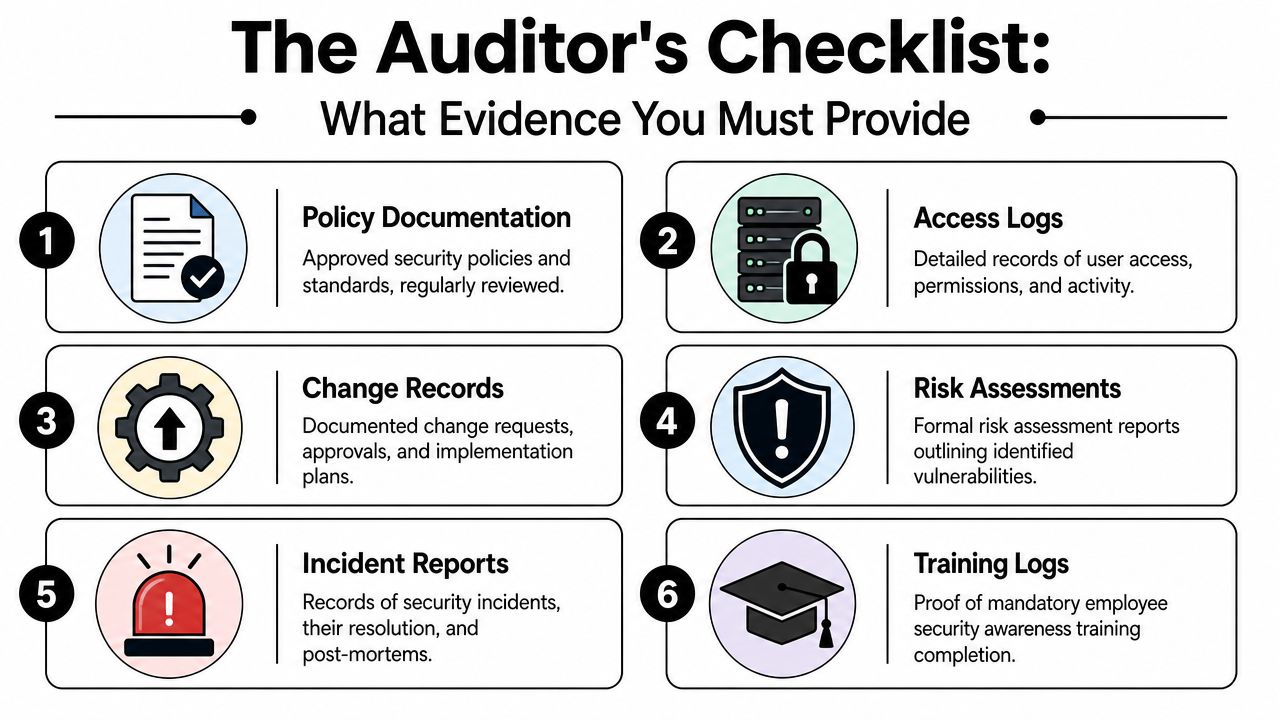
The Auditor's Checklist What Evidence You Must Provide
When an auditor reviews change control, they're asking a simple question in several complicated ways: can your MSP show that changes were governed, not improvised? Policies matter, but documents alone won't carry you. The actual work is in the operating evidence.
Under ITIL 4, Change Enablement replaced legacy Change Management, and auditors assessing frameworks such as SOC 2, ISO 27001, or NIST CSF must test how controls operate in practice, not just on paper. That includes validating evidence of Post-Implementation Reviews that capture root causes and lessons learned, along with an audit trail for every status change and approval, as outlined in Hyperproof's IT compliance audit checklist.
Six artifacts that carry most of the weight
If I'm helping an MSP prepare for a first serious audit, these are the artifacts I want clean before anything else:
-
Approved policy set
Your change policy, approval rules, and role definitions need formal ownership. If policies exist only as draft docs or tribal knowledge, the auditor will spot it quickly. -
Complete change records
Each record should show request details, affected client, risk level, implementation plan, rollback thinking, approvals, timestamps, and closure. -
Role-based access evidence
You need to show that not everyone can approve, implement, and close the same type of change in every tenant. -
Approval workflow history
The approval workflow history is a common point of exposure for many MSPs. Auditors want to see who approved, in what sequence, and whether the approver had the authority to do it. -
Operational logs tied to the change
Not every system log needs to live in the change record, but the record should point clearly to supporting execution evidence. -
Post-Implementation Reviews
If you need a practical model, this guide to creating and managing Post-Implementation Reviews is the kind of structure teams need. A PIR should capture outcome, variance from plan, lessons learned, and any follow-up actions.
What makes evidence usable
Bad evidence isn't usually missing. It's fragmented. There's an approval in Teams, a ticket in PSA, a note in someone's head, and a screenshot from the night of the change. That's not a defensible story.
Usable evidence has three traits:
- Linked: The reviewer can move from policy to change record to approval to implementation evidence without guessing.
- Scoped: It's clear which client tenant, system, and change window the evidence belongs to.
- Consistent: Similar changes produce similar records, even when clients use different approvers.
A control isn't strong because your team says they follow it. It's strong because a third party can reconstruct the workflow without you narrating it.
Mapping ITIL Change Processes to Compliance
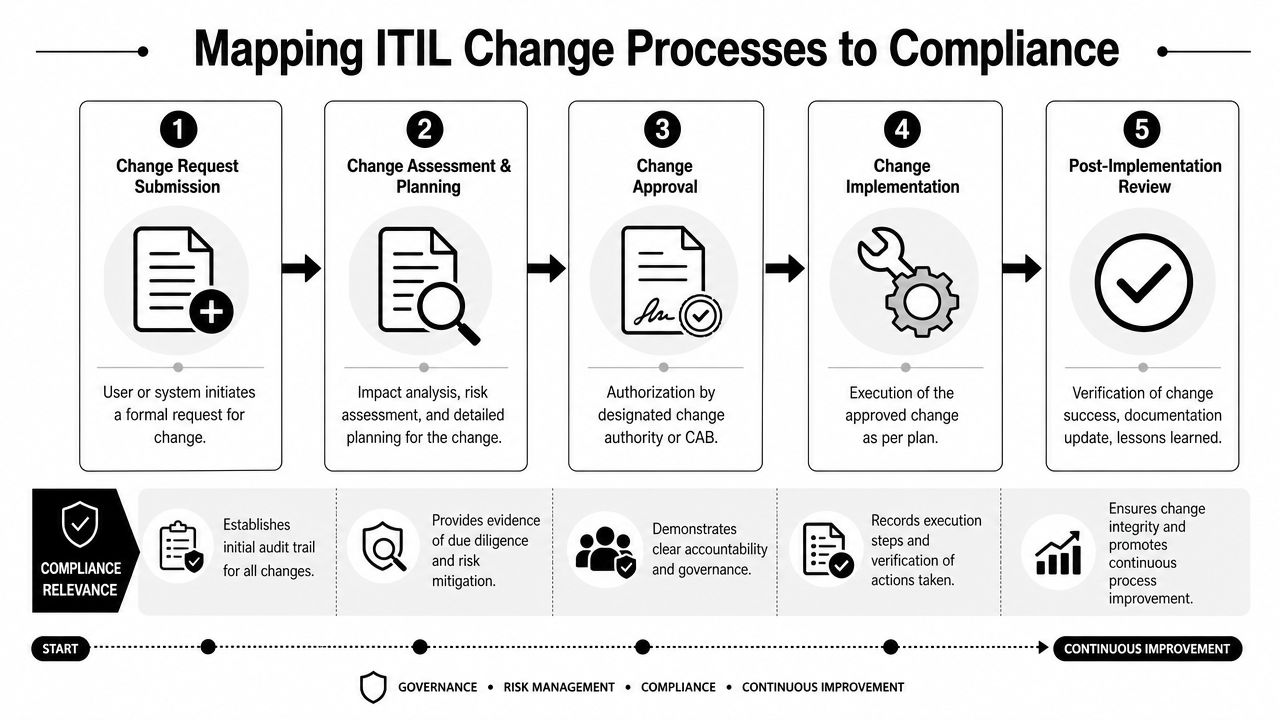
A lot of MSPs assume compliance means adding a second process on top of ITIL. Usually that's the wrong move. If your ITIL-aligned workflow is designed well, it should already generate most of the evidence auditors need.
The useful lens is not “How do we bolt compliance onto change?” It's “Which parts of our change model produce evidence, accountability, and tenant-specific control?”
Normal Standard and Emergency changes produce different evidence
ITIL gives MSPs a practical way to handle different risk levels without forcing every action through the same queue. If you need a refresher on the operating model, this overview of the importance of ITIL change management in modern IT operations is a useful reference.
What matters in audit terms is that each change type leaves a different but still complete trail.
Normal changes should show the fullest record. They need formal assessment, scheduling, approval, implementation detail, and review. This is the cleanest place to demonstrate due diligence in a client environment with meaningful risk.
Standard changes are where mature MSPs gain speed without losing control. The key is that they are pre-approved from a defined template. If a “standard” change gets treated like a blank check, the control fails. If the template is specific, scoped, and tied to known low-risk work, auditors usually understand the logic.
Emergency changes test whether your process is real. A good emergency path allows fast action but still requires documented justification and a post-facto review. If emergency changes never get reviewed, they become a loophole large enough to drive every rushed production action through.
The process is the control
This is the point engineers sometimes resist. They hear “documentation” and assume it slows delivery. In practice, a stable change workflow protects delivery because it removes ambiguity about what must happen before and after production work.
A sound ITIL process naturally creates compliance artifacts:
- Submission creates the initial audit trail
- Assessment records risk thinking and scope
- Approval establishes accountability
- Implementation captures execution
- Review proves the organization learns from outcomes
Once that workflow is enforced consistently across tenants, you don't need a separate “audit process” for every client. You need clean mapping between the same core process and each client's approval and reporting needs.
Common Audit and Compliance Pitfalls for MSPs
Most MSP audit failures don't come from one catastrophic mistake. They come from small inconsistencies that pile up until the organization can't prove control with confidence.
Where MSPs get exposed
The first pitfall is process drift across clients. One account team uses a formal approval path. Another runs mostly through chat and verbal signoff because “the client likes it faster.” That may feel customer-friendly, but it destroys consistency when someone asks how your organization governs production change.
The second is weak tenant separation in evidence. MSPs often have the right information somewhere, but not in a way that clearly shows who acted inside which client environment. In multi-tenant operations, sloppy boundaries create avoidable suspicion.
The third is missing review discipline after implementation. Teams are usually better at getting the change done than documenting what happened, what failed, and what should change next time. That gap matters because it tells auditors the organization may execute changes but doesn't reliably learn from them.
Here are the warning signs I see most often:
- Approvals by convenience: The nearest available person approves, not the designated authority for that client or risk tier.
- Emergency misuse: Routine rushed work gets labeled emergency because the normal path feels inconvenient.
- Access sprawl: Engineers accumulate rights across tenants that no longer match their role.
- Evidence by screenshot: The MSP stores snapshots instead of system-generated history and structured records.
Why observation is not enough
There's another problem that doesn't get enough attention. The Hawthorne Effect. In audit-and-feedback programs, people often perform better when they know they're being observed, which creates a credibility gap in the data. Staff may doubt traditional audit data precisely because observation changes behavior, as discussed in this PMC article on the Hawthorne Effect in audit and feedback.
That lesson applies directly to MSP operations. Manual spot-checks, announced reviews, and one-off observation exercises can produce a clean-looking picture that doesn't reflect day-to-day execution. If your compliance story depends on “we watched the team and they did it correctly,” your evidence is softer than you think.
Good audit data comes from routine system behavior, not from people acting carefully because they know someone is watching.
That's why durable controls matter more than performative ones. You want approvals, access boundaries, timestamps, and reviews captured as part of normal work. Not as theater for an assessment week.
How ChangeBreeze Delivers Audit-Ready ITIL Workflows
At some point, most MSPs hit the same ceiling. They can describe the right process. They can even document it. But they still rely on disconnected tools to execute it. The result is predictable: approval logic in one place, technician notes in another, client-specific rules in someone's memory, and audit evidence assembled by hand.
What a multi-tenant platform fixes
For MSPs, the requirement isn't just “have change management software.” It's “have a system that respects tenant boundaries while enforcing one consistent operating model.” That's the value of a platform built for managed services rather than adapted from a single-company workflow.
ChangeBreeze is one example of that approach. It supports ITIL-aligned workflows for Standard, Normal, and Emergency changes, with multi-tenant separation, role-based permissions, approval routing, and structured Post-Implementation Reviews. For MSP audit and compliance work, those details matter because they tie process execution to evidence generation.
What changes operationally
A dedicated platform changes the daily mechanics in a few important ways:
- Client segregation becomes visible: Each tenant has logical separation, so you can show whose records belong where.
- Approval paths become enforceable: Different clients can require different approvers without turning your process into improvisation.
- Audit trails become native: Status changes, approval actions, and review steps are captured as part of doing the work.
- PIRs stop being optional: The review step is built into the workflow instead of left to technician discipline.
That last point is bigger than it looks. MSPs don't usually fail because they lack smart engineers. They fail because the process depends on smart engineers remembering administrative details during stressful work. Good platforms remove that dependency.
If your team supports multiple regulated or compliance-conscious clients, the goal is simple. One repeatable process. Clear tenant boundaries. Evidence produced by normal operations, not recreated later.
If your MSP is trying to move from ad hoc change control to a cleaner audit posture, take a look at ChangeBreeze. It's built around ITIL-aligned, multi-tenant change workflows that help teams document approvals, segregate client records, and retain the evidence auditors usually ask for.