
A client asks for a full record of every production change made in their environment over the last six months. They want timestamps, approvals, risk notes, rollback plans, and proof that each change was reviewed after implementation. Your engineers know the work happened. Your service desk can probably find some tickets. Your operations lead has CAB notes in a spreadsheet. A few approvals sit in email threads. Emergency fixes live in Teams or Slack messages.
That's the moment when weak change request documentation stops being an admin problem and becomes a business risk.
MSPs feel this pain harder than internal IT teams. You're not managing one company with one approval model. You're managing multiple clients, each with different risk tolerance, approvers, compliance needs, and service expectations. Generic advice built for a single IT department usually breaks down fast in that environment.
Why Your Change Documentation Must Be Audit-Proof
The usual failure pattern is boring until it turns expensive. A technician raises a ticket. An approver replies in email. Someone pastes implementation notes into a PSA. A rollback plan exists, but only in the engineer's head or in a private notepad. Weeks later, nobody can reconstruct the full timeline with confidence.

That might survive routine operations. It won't survive a serious client review, a compliance check, or a high-impact outage where the client wants to know exactly who approved what and why.
Audit gaps become operational gaps
When change request documentation is fragmented, three things happen at once. First, auditors and clients see missing evidence. Second, managers lose confidence in the approval process. Third, engineers waste time rebuilding context instead of fixing the next issue.
A complete record has to show more than intent. It has to show the decision trail. That means the request, the risk thinking, the approvals, the implementation window, the outcome, and the review after the work is done. If your team runs PIRs inconsistently, it helps to standardize post-implementation reviews so the record doesn't end at deployment.
Good documentation doesn't slow a mature team down. It prevents the same argument from happening again after every incident.
The single source of truth matters
Most MSP owners don't need more forms. They need one defensible system of record. Spreadsheets, chat logs, and mailbox folders aren't a control framework. They're a scavenger hunt.
What works is a single workflow where each change record contains:
- The request itself with business and technical context
- The approval path that fits the client and the change type
- Implementation notes tied to the actual execution
- Validation evidence showing whether the change succeeded
- Review outcomes documenting lessons learned and follow-up actions
What doesn't work is spreading those pieces across five tools and calling it “documented.”
Practical rule: If an auditor or client needs a technician to explain where the missing pieces are, the process isn't audit-proof.
Audit-proof change request documentation is really about trust. Clients trust that you can show your work. Managers trust that changes were controlled. Engineers trust that if something goes wrong, the record will help them recover fast instead of forcing them into blame-driven archaeology.
The Anatomy of an Ironclad Change Request
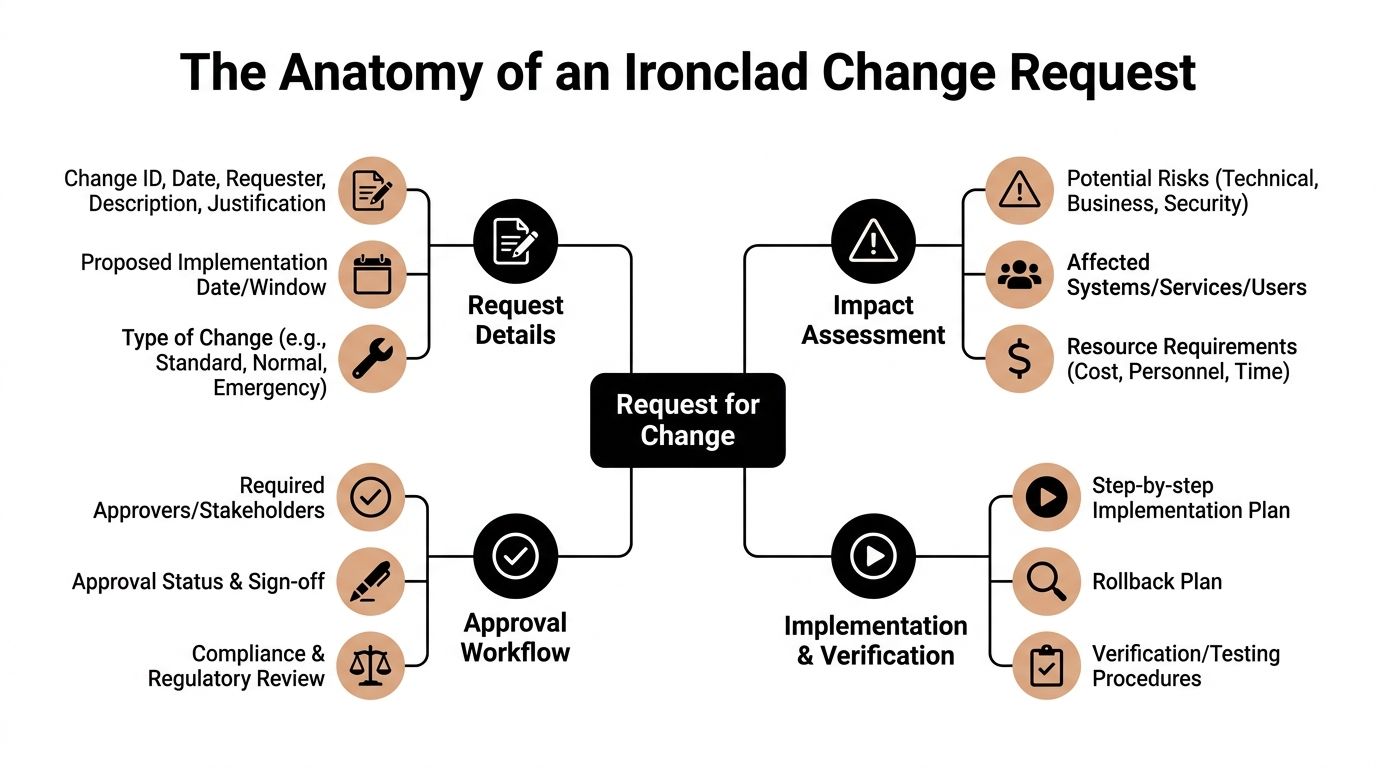
A strong RFC is a working control, not a polite request form. It gives approvers enough information to make a decision, implementers enough detail to execute safely, and auditors enough evidence to understand what happened later.
A practical structure follows a five-step methodology: request, impact analysis, approval, execution with monitoring, and post-implementation review. In Step 1, the RFC should capture business justification, technical details, risk assessment, implementation plan, and rollback procedures as mandatory fields. Step 2 requires impact and risk analysis. Step 3 applies tiered approval. Step 4 executes the change with monitoring. Step 5 closes with a PIR, as outlined in Monday.com's ITIL change management best practices.
Start with the business case
The first fields should answer a simple question. Why should anyone approve this?
That starts with clear business justification. “Patch server” is not enough. “Apply vendor security update during approved maintenance window to reduce exposure on a client-facing application” is useful. The difference is that the second version gives approvers context, urgency, and business relevance.
Your request details should include:
- Requester and ownership so there's no doubt who raised the change and who is accountable for delivery
- Technical scope listing systems, services, devices, or applications affected
- Change type so the record follows the right path from the start
- Planned implementation window because timing affects risk as much as the technical work itself
A weak RFC usually fails here. It asks the approver to infer the purpose and accept unknown risk.
Treat risk and impact as decision inputs
Risk scoring isn't there to make the form look mature. It helps the team decide whether the change should be fast-tracked, scheduled differently, escalated, or rejected.
Good change request documentation identifies what might break, who might notice, and what dependencies sit behind the proposed work. A risk section should force the requester to think through business impact, technical impact, security considerations, affected users, and service dependencies.
I prefer structured fields over free text for this part. A scoring matrix makes patterns visible. Free-form narratives often hide them.
Use the risk and impact section to capture:
- Potential service disruption including what users or systems could lose access
- Dependency risk such as integrations, shared infrastructure, or upstream and downstream systems
- Validation approach showing how the team will confirm success
- Rollback conditions describing when the team will stop and reverse
The best RFCs make approval easier because they reduce the number of follow-up questions.
Build approval and execution into the same record
A common design mistake is separating “approval” from “implementation” so completely that nobody can follow the flow end to end. The record should show not only that the change was approved, but also by whom, under what conditions, and with what evidence.
That means your RFC needs:
- An approval matrix that maps change type and risk level to the right approvers
- Implementation steps written for the engineer who will perform the work, not for an auditor reading six months later
- Rollback steps detailed enough that another qualified technician could execute them under pressure
- Validation checkpoints before, during, and after implementation
Short implementation plans are fine for routine work. Vague implementation plans are not. “Update firewall rules and test” is not a plan. A proper implementation section should identify sequence, dependencies, validation, communication points, and stop conditions.
The last field many teams underrate is the PIR trigger. Don't treat PIR as a separate administrative event that may or may not happen. Add it to the original record so the change isn't considered complete until the review is done.
Documenting Standard Normal and Emergency Changes
Trying to document every change with the same level of rigor annoys engineers and clogs approval queues. It also creates the wrong kind of control. Low-risk, repeatable work gets buried under bureaucracy, while high-risk work still doesn't get the scrutiny it deserves.
Why one process for every change fails
The cleaner model is to scale documentation to risk.
For standard changes, the goal is repeatability. For normal changes, the goal is evaluation and control. For emergency changes, the goal is speed with disciplined follow-through after the fact.
Elite-performing IT teams aim for 40% to 60% of total change volume to run as pre-approved standard changes, which frees documentation effort for higher-risk work, according to Motadata's discussion of ITIL change management best practices.
That target matters because many MSPs still waste senior time reviewing the same safe routine change over and over. If CAB approved the same change twice and it remains low-risk and repeatable, document it as a standard model and stop forcing it through full review every time. If you need a repeatable way to do that, this guide on creating standard change templates is a practical reference.
Documentation Requirements by Change Type
| Requirement | Standard Change | Normal Change | Emergency Change |
|---|---|---|---|
| Purpose | Pre-approved routine work | Planned change needing evaluation | Urgent work to address active risk or service impact |
| Justification | Reference to approved template and use case | Full business and technical justification | Immediate reason for expedited action |
| Risk assessment | Based on established low-risk model | Detailed impact and dependency review | Rapid risk statement with known consequences |
| Approval | Pre-approved workflow | Formal multi-stage approval | Expedited approval under emergency authority |
| Implementation plan | Reusable documented steps | Change-specific implementation steps | Fast but explicit execution steps |
| Rollback plan | Template-based rollback | Detailed rollback tailored to the environment | Immediate fallback steps documented before action when possible |
| Review | Periodic template review | Standard PIR | Mandatory retrospective review |
A few practical distinctions matter:
- Standard change records should be short, but they still need traceability. The template should hold the core method, and each execution should record who did it, when, for which client, and whether the result matched the expected outcome.
- Normal change records need the fullest documentation because they carry the most planning burden. Weak impact analysis in such cases causes rework, stalled approvals, and noisy CAB discussions.
- Emergency change records must not become “we fixed it and documented it later, maybe.” Fast-track doesn't mean undocumented. It means document the justification, log the authority used, execute, then review hard afterward.
If your emergency workflow skips disciplined review, the same emergency tends to come back wearing a different ticket number.
What works is matching the record depth to the actual risk. What doesn't work is pretending all changes are equal, then wondering why technicians hate the process and approvers stop taking it seriously.
Solving the Multi-Tenant Challenge for MSPs
Generic ITIL advice usually assumes one company, one CAB pattern, one policy set, and one compliance context. MSPs don't live in that world.
One client wants unanimous approval for network changes. Another is fine with a technical approver and an operations approver. One needs tighter evidence retention. Another requires a different risk classification. If your team handles that with separate forms, scattered rules, and tribal memory, the process won't scale.
Why MSP documentation breaks in shared systems
The central MSP problem isn't just volume. It's workflow fragmentation.
A documented gap in current guidance is that 68% of MSPs report approval workflow fragmentation as a top bottleneck, while common advice still ignores the need for dynamic fields and client-specific approval paths inside one interface, as noted in Pipefy's change request discussion.
That finding matches what many MSP operations leads already know from experience. Single-company tools often force one of two bad choices:
- Over-standardize everything, which means some client requirements get bypassed or handled outside the system
- Create separate forms for each client, which turns documentation into a maintenance burden
Both approaches create audit pain. The first one creates control gaps. The second one creates inconsistency and admin drag.
What a multi-tenant schema needs to handle
A workable MSP design starts with a shared core schema and client-specific logic layered on top. The form shouldn't change philosophically from client to client. The routing, required fields, risk thresholds, and approval steps should.
That means your change request documentation system should support:
- Tenant-aware fields so the same RFC structure can trigger different requirements based on client
- Client-specific approval paths including different approver roles, thresholds, or review groups
- Logical separation of records so one client's audit trail never leaks into another client's workspace
- Role-based visibility so engineers, approvers, account managers, and auditors only see what fits their role
A practical example is the risk section. The field labels can stay consistent, but one client may require explicit compliance review for infrastructure changes while another doesn't. The workflow should respond automatically to that tenant context.
Shared process, isolated records, client-specific logic. That's the MSP version of mature change control.
This is also where many teams underbuild evidence capture. In a multi-tenant model, every record has to answer two questions at once. Was the work properly controlled? And was it controlled according to this specific client's rules?
If your tool can't express both, the engineers will work around it. Once they do, your audit trail is no longer trustworthy.
Best Practices for a Living Documentation Record
A closed change with no outcome data is just a historical note. Mature change request documentation keeps evolving after implementation. It records what happened, whether the plan held, what failed, what was learned, and what should change next time.
That's where many teams still fall short. They create an RFC, get it approved, complete the work, and stop documenting when the ticket status flips to done.
Close the loop after implementation
The PIR is where documentation becomes useful instead of ceremonial.
A strong PIR captures the actual outcome, user impact, unexpected side effects, root cause of issues, and specific follow-up actions. It should also confirm whether the original risk assessment was accurate and whether the rollback plan was usable in practice.
52% of change-related incidents stem from insufficient rollback procedures documented in the RFC, and 45% of MSPs face penalties for incomplete change evidence because their forms don't link to real-time system states or executable rollback scripts, according to ChangePlan's write-up on change management best practices.
A useful post-implementation checklist includes:
- Outcome verification confirming whether the technical and business objectives were met
- Deviation review documenting what differed from the plan and why
- Rollback assessment noting whether rollback was tested, used, or found incomplete
- Improvement actions assigning follow-up work, template changes, or knowledge updates
Documentation should answer "what happened" without requiring a memory contest between the engineer and the manager.
Move from static records to evidence-linked records
Static forms are the old model. A modern record should pull in supporting evidence from the systems involved.
That doesn't mean every RFC needs a giant appendix. It means the record should link to the proof that matters: monitoring snapshots, implementation logs, validation results, attached rollback scripts, release references, and supporting tickets. During an emergency change, that evidence often matters more than polished prose written later.
What works well in practice:
-
Attach live evidence at the time of change
Pull in telemetry, test output, or change window observations while the work is happening. -
Store rollback artifacts with the RFC
Don't say a rollback exists if it lives in a separate repository with no reference in the record. -
Update configuration and knowledge records after success
If the environment changed, the supporting documentation has to change too. -
Review standard templates using PIR findings
Repeated friction in the same type of change usually means the model needs updating.
Static PDFs and generic web forms tend to fail here because they freeze the story too early. A living record stays useful for auditors, for root cause analysis, and for the next engineer who has to touch the same system months later.
From Change Control to Change Enablement
The old view of change management treated documentation like a gate. Engineers filled out forms so a board could decide whether they were allowed to proceed. That mindset creates friction fast, especially in MSPs where technicians already juggle client context, scheduling constraints, and competing priorities.
The better view is change enablement. Good change request documentation gives the team a trusted way to move faster without losing control. Approvers get the information they need without chasing people. Engineers know what evidence to capture. Clients get a clean audit trail. Service managers can see where risk is rising before it turns into an outage.
That shift changes behavior. Standard work gets templated. Normal work gets thoughtful review. Emergency work gets disciplined follow-up. Multi-tenant complexity stops living in tribal knowledge and starts living in the workflow itself.
The teams that move fastest aren't the ones with the fewest controls. They're the ones whose controls are clear enough that nobody has to fight them.
If your current process depends on inboxes, meetings, and memory, it won't keep up. If it gives technicians one clean path to request, approve, implement, verify, and review changes, it becomes an operational advantage. That's the point. Better documentation isn't about producing more paperwork. It's about making safe change easier to execute at scale.
If you need a system built for MSP change control instead of a retrofitted single-company workflow, ChangeBreeze is worth a look. It supports ITIL-aligned standard, normal, and emergency changes, client-specific approval paths, complete audit trails, and PIR workflows in a multi-tenant platform that technicians can readily use day to day.