
It's late, your engineers are wrapping up, and a client tickets in with a production issue that wasn't there this morning. The trail leads back to a change that looked routine when it was submitted. Maybe it was a firewall tweak, a patch window, or a configuration adjustment on a shared platform. The technical fix is usually the easy part. The harder part is explaining why the risk wasn't spotted before the change went live.
That's where most MSP change processes break down. They document the request, collect an approval, and move on. They don't create a reliable way to judge risk across different client environments, different engineers, and different levels of business sensitivity. The result is inconsistency. One technician flags a change as high risk. Another marks a similar change as low risk because the form leaves too much room for opinion.
That inconsistency matters. Research consistently shows that approximately 70% of organizational change initiatives fail to achieve their stated goals, often because of weak stakeholder engagement and poor upfront risk assessment, as summarized in this change management risk assessment overview. For MSPs, the problem is sharper because you're not managing one estate. You're managing many. Each client has its own tolerance for disruption, approval expectations, compliance obligations, and operational blind spots.
A practical change management risk assessment process fixes that. Not by adding layers of ceremony, but by giving technicians and approvers one shared method for deciding what needs scrutiny, what can move fast, and what should never be treated as routine.
Building Your Change Risk Assessment Framework
A usable framework starts with one principle. Risk scoring has to be boringly consistent. If every engineer interprets “high impact” differently, the matrix becomes decoration.
Old-school change boards often create the opposite outcome. They bury teams in long forms, ask broad questions nobody can score consistently, and force managers to debate risk from scratch every time. That feels compliant, but it isn't operationally strong. A better model uses a short set of defined criteria that technicians can apply without a meeting.
Start with shared criteria
Treat impact and likelihood as separate decisions.
Impact answers: if this change goes wrong, what happens? Likelihood answers: how plausible is failure in this specific situation? Don't blend them into one judgment.
For MSP environments, impact usually needs to consider more than the technical blast radius:
- Service disruption: Will users lose access to a business service?
- Security exposure: Could the change weaken controls or create an opening for misconfiguration?
- Operational dependency: Does it affect backup jobs, integrations, identity services, or monitoring?
- Client sensitivity: Is this a routine line-of-business system, or a heavily scrutinized client platform?
- Recovery difficulty: Can the team roll back quickly, or is reversal messy and uncertain?
Likelihood should be scored from execution realities, not confidence alone:
- Change complexity: Is this a straightforward repeatable task or a one-off adjustment?
- Testing quality: Was it tested in a representative environment?
- Team familiarity: Has the assigned engineer implemented this type of change before?
- Timing risk: Is the work happening under time pressure or during a congested window?
- Dependency risk: Are multiple teams, vendors, or platforms involved?
Practical rule: If a criterion can't be explained in one sentence to a technician, it's too vague to score consistently.
Prosci's research is useful here because it ties structure to outcomes. Organizations using a formal risk-assessment framework at the start of change initiatives can reduce adoption risk by approximately one-third, with 65–70% of projects achieving adoption goals when top risks are explicitly managed, compared with about 40% when they are not, according to Prosci's risk assessment guidance.
Use a simple matrix that engineers will actually use
A 5x5 matrix is usually enough. It's familiar, quick to explain, and flexible enough for client variation. The mistake isn't the matrix itself. The mistake is failing to define what each scale point means in your operating model.
| Likelihood ↓ / Impact → | 1 - Insignificant | 2 - Minor | 3 - Moderate | 4 - Major | 5 - Catastrophic |
|---|---|---|---|---|---|
| 1 - Rare | Low | Low | Low | Low | Medium |
| 2 - Unlikely | Low | Low | Medium | Medium | High |
| 3 - Possible | Low | Medium | Medium | High | High |
| 4 - Likely | Medium | Medium | High | High | Critical |
| 5 - Almost Certain | Medium | High | High | Critical | Critical |
This only works if each score has a plain-language definition in your process. For example, “2 - Minor” impact might mean limited user inconvenience with an easy rollback. “4 - Major” might mean service interruption, executive visibility, or contractual escalation risk. The exact wording should fit your client portfolio, but the scoring logic must stay stable.
A good framework also includes ownership. Every identified risk needs a mitigation action, a named owner, and a place in the workflow. If the matrix says a change is high risk but the process doesn't trigger extra controls, the score has no operational value.
The best frameworks don't try to predict everything. They force the right conversation early enough to change the implementation plan.
How to Score Impact and Likelihood in Practice
Theory breaks down the moment a technician has to score a real change at speed. That's why examples matter. The point isn't to make every score identical. The point is to make every score defensible.
The visual below captures the practical flow.
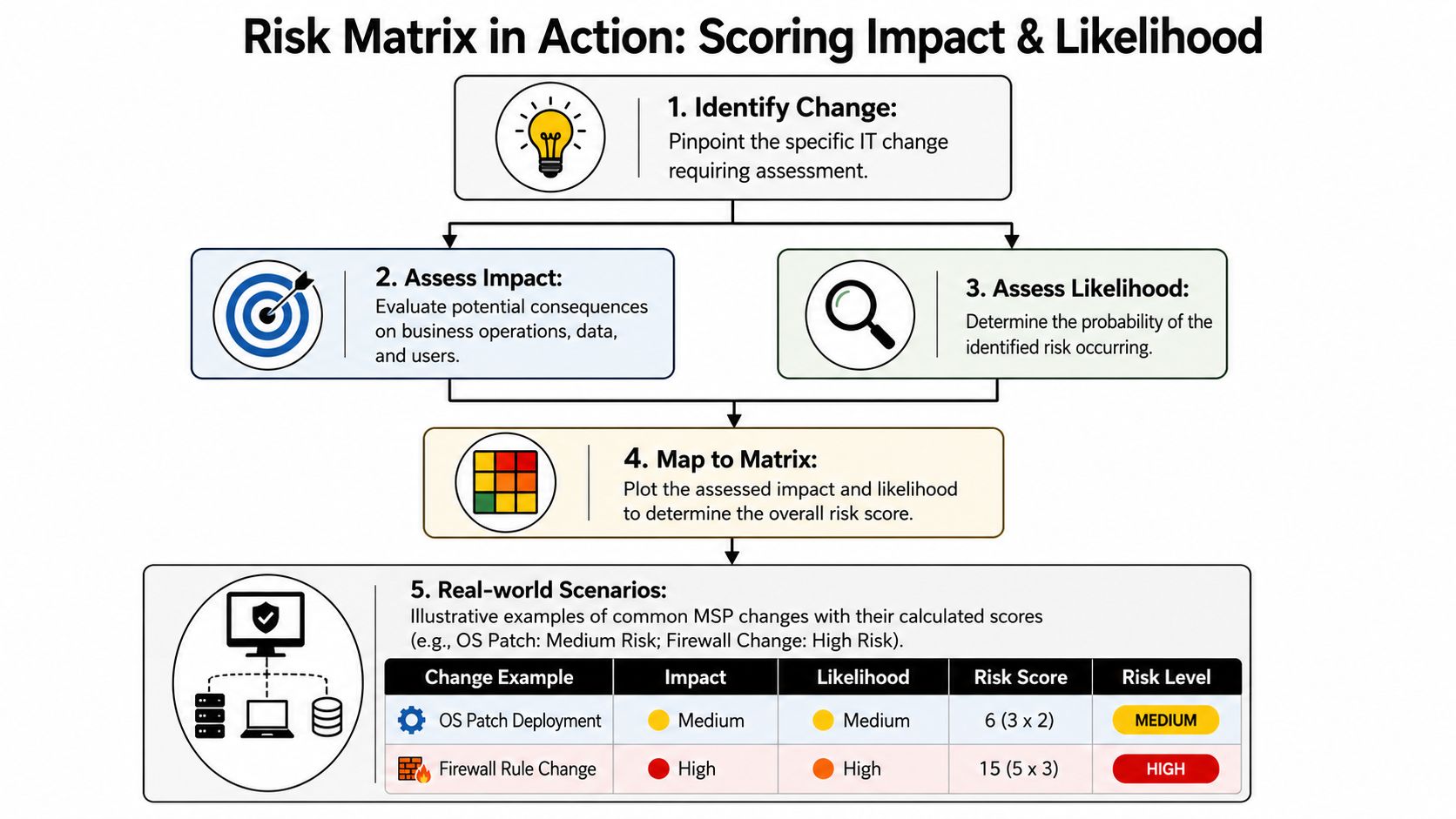
Three common MSP scenarios
Start with something simple. A technician updates a user's group membership and mailbox permission set after an approved access request. The likely impact is low because the change affects one user and doesn't touch shared infrastructure. Likelihood is also low if the task follows a standard script and the engineer performs it routinely. In most MSP environments, this lands as low risk.
Now take a patch deployment on a non-critical internal application server. The impact isn't trivial because service degradation could still affect a department or business process. But it's also not catastrophic if the server is non-critical, the patch is vendor-supported, and a rollback plan exists. Likelihood rises if the server has dependencies that aren't fully mapped or if testing was limited. This often lands in the medium risk range.
The third example is the one that catches teams out. A firewall rule change for a major client may look narrow on paper, but the impact can be substantial if the rule sits in the path of customer-facing applications, VPN connectivity, or partner traffic. Likelihood also climbs if the rule logic is complex, the request is urgent, or nobody has verified the full dependency chain. That's often high risk, even if the change itself takes only a few minutes to implement.
What separates defensible scoring from guesswork
Good scoring uses evidence from the request, not the confidence level of the person submitting it. A practical review sounds like this:
- For impact: Which services, users, controls, or integrations could be affected if this fails?
- For likelihood: How much uncertainty remains after testing, peer review, and implementation planning?
- For recovery: Can we back out cleanly, and do we know how long recovery will take?
- For client context: Would this same failure be treated differently for this client than for another?
Here's the pattern I've seen repeatedly. Teams under-score risk when they focus only on the target system. They score better when they assess the surrounding environment. The switch itself may be easy. The dependency chain rarely is.
Don't ask, “Is this change hard?” Ask, “What happens if we're wrong, and how many things have to go right for this to work?”
A reliable change management risk assessment also separates repeatable work from familiar work. Engineers often say a task is low risk because they've done “something like it” before. That isn't enough. Familiarity lowers likelihood only when the current change matches a proven pattern, uses a documented method, and has a rollback that the team can execute.
Connecting Risk Scores to ITIL Change Types
A risk score should trigger workflow, not debate. If your service desk still argues case by case over whether something is standard, normal, or emergency, the scoring model isn't doing enough work for you.
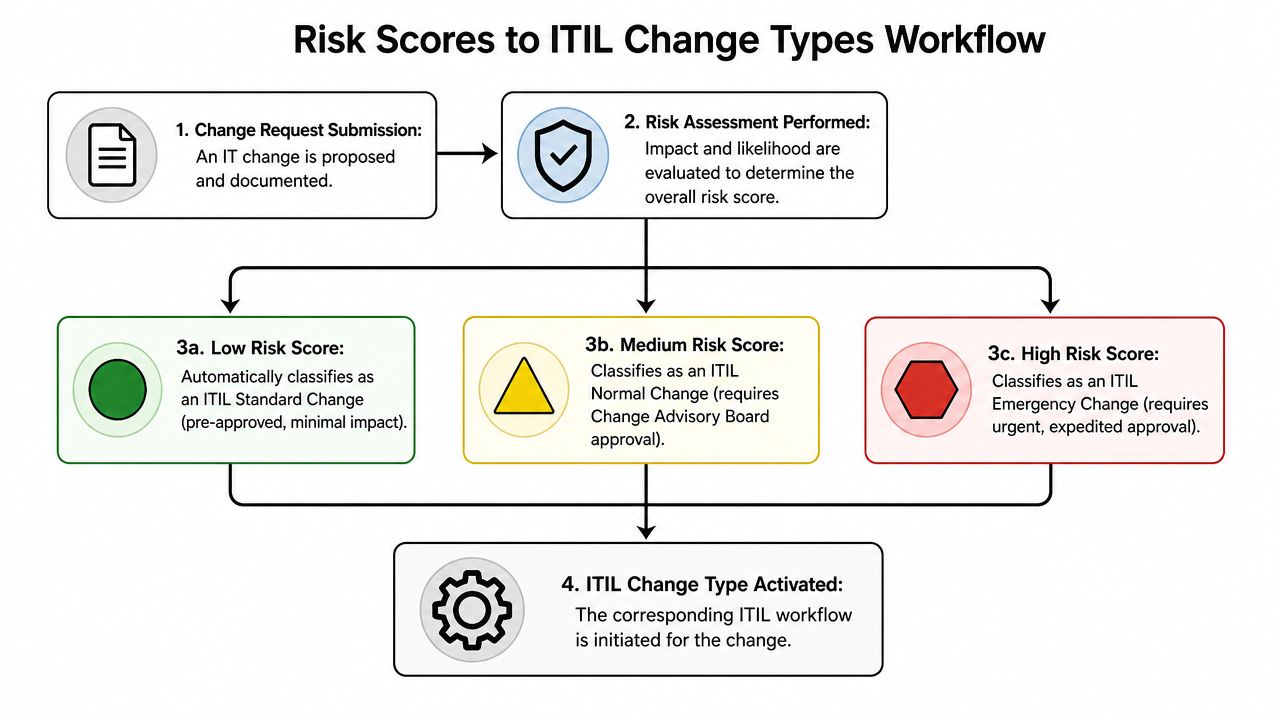
Let the score drive the path
In practical ITIL terms, the cleanest operating model is usually:
| Risk result | Typical ITIL treatment | Workflow expectation |
|---|---|---|
| Low | Standard change | Pre-approved template, documented safeguards, lightweight review |
| Medium | Normal change | Formal assessment, scheduled implementation, approver review |
| High | Normal change with enhanced scrutiny | Broader approval, stronger testing evidence, explicit rollback and communications |
| Critical with urgent business need | Emergency change | Expedited approval with documented justification and post-change review |
That mapping keeps the process understandable. Low-risk, repeatable changes shouldn't queue behind avoidable approvals. High-risk changes shouldn't slip through because the requester wrote a neat summary.
For teams that need a sharper distinction between these paths, this explanation of standard, normal, and emergency change models is a useful reference point for how the categories behave operationally.
Where teams usually overcomplicate it
The common failure mode is adding exceptions everywhere. A standard change gets an extra manager sign-off “just in case.” A high-risk network change gets treated as normal because a senior engineer is doing it. An emergency path gets used for poor planning rather than real urgency.
That creates two problems. First, technicians stop trusting the process because similar changes take different routes. Second, auditors and clients see inconsistency in the approval record.
A stronger design uses the risk score as the main routing signal and only allows exceptions with documented rationale. In practice, that means:
- Low risk: pre-approved only if the task is repeatable, documented, and proven.
- Medium risk: routed to the right approver group based on service ownership and client context.
- High risk: reviewed by people who understand business impact, not just technical execution.
- Emergency: allowed when urgency is real, then examined afterward without excuses.
A mature process doesn't try to remove judgment. It puts judgment in the places where it adds value instead of forcing it into every routine request.
When MSPs wire this into their tooling, the change type stops being a subjective label. It becomes the output of a defined risk decision. That's the point where the process starts to feel lighter, not heavier.
Tailoring Risk Assessments for Multiple MSP Clients
Single-enterprise advice often falls apart in MSP operations because it assumes one risk appetite, one governance model, and one set of business priorities. You don't have that luxury. You may support a small professional services client that values speed above formality, a healthcare client that expects stricter approval discipline, and a financial client that wants explicit separation between requesters and approvers.
The risk process can't change shape every time an engineer switches tenants. The scoring logic has to stay recognizable while the client treatment changes where it should.
Why one global matrix fails in a multi-client model
A shared matrix is useful. A shared interpretation of consequences is not always possible.
The same server reboot can be a low-stakes maintenance task for one client and a highly sensitive event for another because the business context is different. The same firewall adjustment may go unnoticed in one environment and trigger regulatory concern in another. If your process ignores that, technicians either overscore everything to stay safe or underscore everything to keep work moving. Both are bad habits.
The answer isn't to create a different methodology for every client. That turns governance into chaos. The answer is to keep one core model and vary the inputs that matter:
- Client criticality rules: Which services are classed as business-critical for that client?
- Approval expectations: Which changes need client-side approval, technical review, or operational sign-off?
- Baseline sensitivity: Should certain categories begin at a higher starting risk?
- Evidence requirements: Does this client expect test notes, communication plans, or implementation checkpoints before approval?
- Escalation paths: Who gets pulled in when the score crosses a threshold?
Use templates to standardize without flattening client differences
Templates demonstrate their worth. A well-built change template doesn't just save typing. It embeds a known risk posture for a repeatable scenario.
For example, an MSP might maintain different templates for a routine endpoint software deployment, a production firewall change, and a line-of-business application update. The structure stays consistent, but the template can pre-fill affected services, prompt the right risk questions, and route the request to the appropriate approvers for that client.
Here's what that looks like in a modern platform.
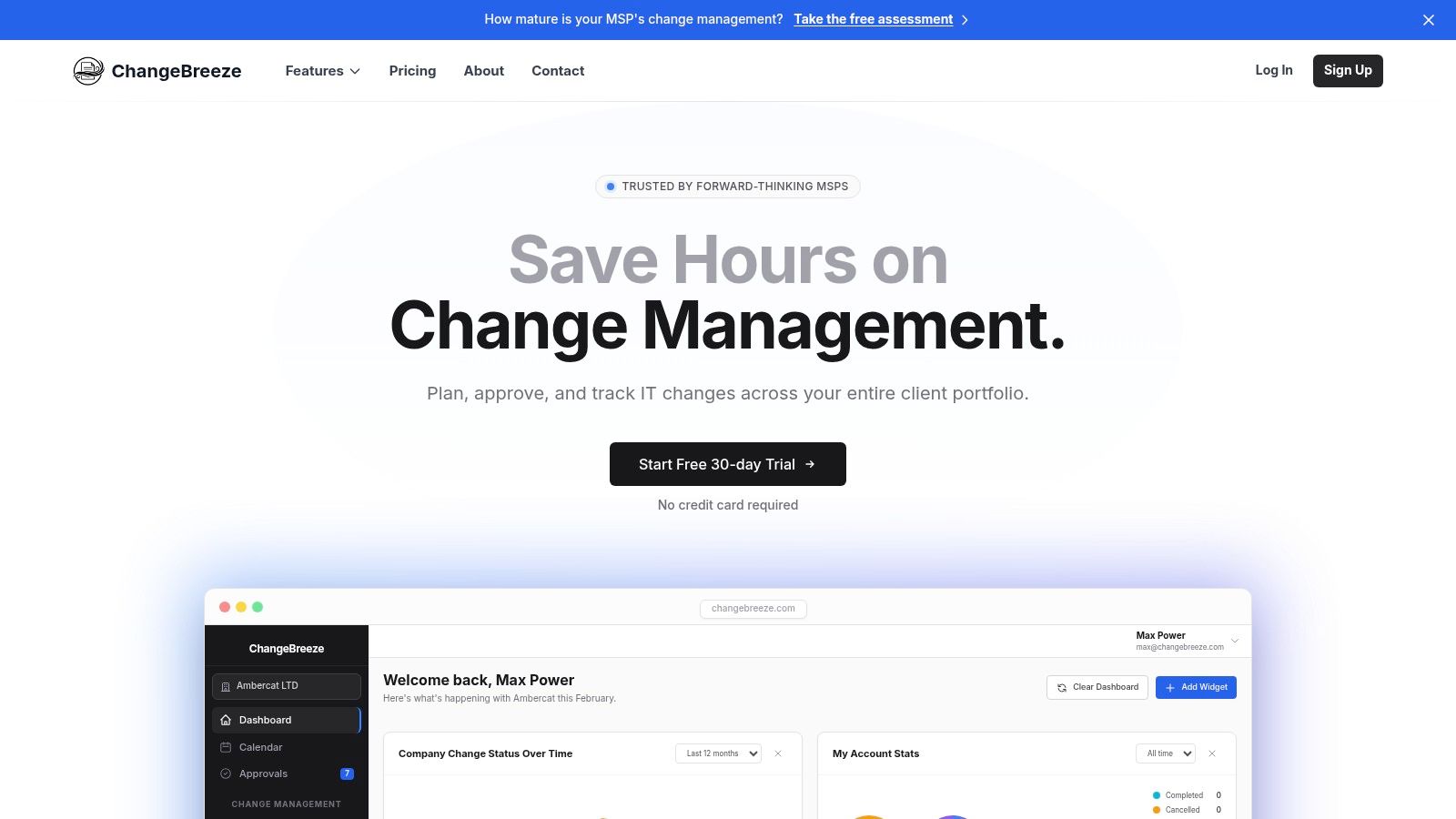
A multi-tenant tool matters here because MSPs need separation and consistency at the same time. ChangeBreeze is one example of a platform built around that model. It supports ITIL-aligned workflows across multiple client companies, with role-based access, client-specific approval paths, and support for standard, normal, emergency, and post-implementation review activity. That's the kind of structure that lets an MSP maintain one internal operating discipline without pretending every client should be handled the same way.
If your engineers have to remember each client's unwritten rules, the process isn't mature. It's tribal knowledge with a form attached.
The practical target is simple. A technician should be able to open a client-specific template, answer a short set of meaningful risk questions, and trust that the system will route the change in line with that client's expectations. That reduces friction for the team and gives clients visible evidence that you understand their environment rather than treating them as another ticket queue.
Using Risk Data for Audits and Continuous Improvement
The approval decision is only half the story. The long-term value of change management risk assessment comes from the trail it leaves behind.
When regulators, auditors, or enterprise clients review your process, they're not looking for a polished policy document. They want to see that risk was assessed, that the right people approved the change, and that the organization learned from the outcome. In regulated sectors, that scrutiny isn't theoretical. The UK Financial Conduct Authority has reported that approximately 17% of major business incidents at regulated firms can be traced directly back to failures in technology changes, according to this summary of FCA-linked change risk guidance.

Audit evidence comes from discipline, not from scramble mode
A mature audit trail shows more than timestamps. It shows reasoning.
Useful records usually include:
- The original score: impact, likelihood, overall risk, and the factors used to justify them.
- The approval chain: who approved, in what role, and whether the path matched the assessed risk.
- Implementation evidence: planned window, communications, test notes, and rollback preparation.
- Outcome data: successful, backed out, partially successful, or failed, with a brief factual summary.
That record changes the audit conversation. Instead of scrambling to explain why a change was approved, you can show the full decision path and whether the implemented controls matched the assessed exposure.
Use PIRs to recalibrate the model
The post-implementation review is where the model gets smarter. A low-risk change that still caused disruption isn't proof that the framework failed. It may reveal a hidden dependency, a poor template, or a scoring definition that needs tightening. A high-risk change that went smoothly doesn't mean the score was wrong either. It may mean the mitigation plan worked.
That's why PIR data should feed back into the matrix, the templates, and the approval rules. Teams that treat PIRs as a checkbox lose the most valuable part of the process.
For MSP teams formalizing that feedback loop, this guide to creating and managing post-implementation reviews is a practical reference for turning outcome reviews into repeatable operational discipline.
A good review asks a short list of hard questions:
- Was the predicted impact accurate?
- Did the likelihood assessment reflect the actual execution conditions?
- Were the mitigations used, and did they work?
- Should this change type be templated differently next time?
The strongest change programs don't just approve better. They remember better.
That memory is what turns a compliance artifact into an operating advantage.
Introduction
Most MSPs don't have a change problem. They have a decision-quality problem.
Changes are happening every day. Accounts are updated, policies are adjusted, servers are patched, integrations are modified, and security controls are tuned. The issue is that many teams still assess risk informally. One engineer relies on experience. Another relies on instinct. A manager steps in when something “feels important.” That may work for a while, but it won't hold up across a client portfolio.
The bureaucratic answer used to be bigger forms and longer CAB meetings. In practice, that just shifts pain around. Engineers spend more time writing than thinking. Approvers skim. Urgent changes bypass the process because the normal path is too slow. None of that improves control.
A practical change management risk assessment process does something different. It shortens the path for low-risk work, adds rigor where consequences are real, and creates evidence you can use later. For MSPs, that matters twice. You need to protect service quality, and you need to show each client that your process fits their environment.
The most effective model is usually the least dramatic one. Clear criteria. Repeatable scoring. Risk-based routing. Client-aware templates. Outcome reviews that sharpen the next decision.
Conclusion
A structured change management risk assessment process isn't about making change slower. It's about making risk visible early enough to act on it.
For MSPs, that means building one scoring model your team can trust, tying it to ITIL workflows that fit the actual level of risk, and adapting the process to each client without reinventing it every time. It also means treating the record of each change as operational evidence, not as paperwork.
When that discipline is in place, approvals get cleaner, audit conversations get easier, and technicians spend less time guessing what “high risk” means. The process becomes predictable. That's what clients notice.
If you're standardizing change control across multiple client environments, ChangeBreeze provides an ITIL-aligned platform for documenting, approving, implementing, and reviewing changes with multi-tenant support, role-based approvals, and built-in workflows for standard, normal, emergency, and post-implementation review activity.